

As critical components for achieving rigid connections between shafts in precision transmission systems, the selection of the connection method for rigid couplings directly affects system alignment accuracy, torque transmission reliability, and operational stability. Taking the COUP-LINK LK13 series rigid couplings as the research object, this paper systematically analyzes the structural principles, performance characteristics, and applicable scenarios of the clamping type and set screw type connection methods. By comparing differences in concentricity, torque capacity, shaft damage, installation convenience, and dynamic response, a decision-making method for selection based on specific operating conditions is proposed. The research shows that the clamping type is suitable for high-precision, high-speed, and frequent start-stop applications, while the set screw type is suitable for light-load, low-speed, cost-sensitive applications. This paper provides theoretical basis and practical guidance for engineering selection of rigid couplings.
In the niche field of rigid couplings, COUP-LINK offers high-reliability connection solutions for precision transmission with dual material options (aluminum alloy and stainless steel), multiple accuracy grades, and flexible choices between clamping and set screw types.
2. Basic Requirements for Rigid Couplings
2.1 Core Characteristics of Rigid Connections
Zero Backlash: No elastic elements or moving parts, theoretically absolutely no clearance.
High Torsional Stiffness: The material's elastic modulus determines stiffness; minimal deformation when transmitting torque.
High Alignment Requirements: Cannot compensate for radial, angular, or axial misalignment; precision alignment is mandatory during installation.
Compact Structure: Small external dimensions, suitable for space-constrained applications.
2.2 Overview of the COUP-LINK LK13 Series
The COUP-LINK LK13 series rigid couplings include:
Standard Type: Outer diameters 16–50 mm, clamping type structure.
Fixed Miniature Type: Small dimensions, suitable for encoders and micro motors.
Materials: Aluminum alloy (LK13-C series) for lightweight; stainless steel (SLK13-C series) for corrosion resistance.
Bore Tolerances: Multiple options including H7, H8, G7, F8.
Long Type (L) available: Increased clamping length for higher torque capacity.
3. Analysis of Clamping Type Connection
3.1 Structural Principle
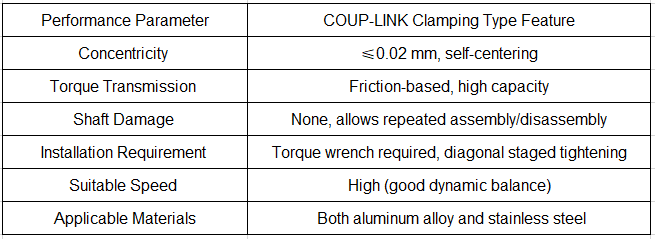
The COUP-LINK LK13 clamping type rigid coupling uses axial bolts and a slotted hub design. When the bolts are tightened, the hub bore contracts uniformly, generating radial pressure and achieving a keyless friction connection with the shaft.
3.2 Performance Characteristics
3.3 Advantages and Limitations
Advantages:
No shaft surface damage, no stress concentration
High repeatable installation accuracy
Suitable for high-speed rotation
High torque capacity
Limitations:
Relatively longer installation time
Slightly longer axial dimension
4. Analysis of Set Screw Type Connection
4.1 Structural Principle
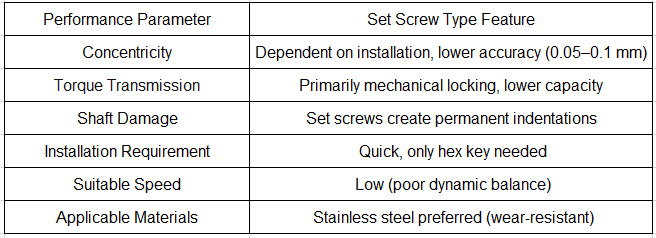
COUP-LINK also offers set screw type rigid couplings (selected models). They use radially positioned set screws to directly clamp the shaft surface, often supplemented by keyways or D-shaped flats to prevent relative rotation.
4.2 Performance Characteristics
4.3 Advantages and Limitations
Advantages:
Quick installation, no special tools required
Low cost
Short axial dimension
Limitations:
Damages shaft surface, poor repeatable accuracy
Limited torque capacity
Unsuitable for high-speed or vibrating environments
5. Comparison and Selection of the Two Connection Methods
5.1 Performance Comparison Table
5.2 Selection Decision Matrix
5.3 COUP-LINK LK13 Series Selection Example
According to COUP-LINK ordering code rules:
LK13-C16-06-06: Aluminum alloy clamping type, outer diameter 16 mm, bores 6×6 mm, standard type.
SLK13-C25-10-10: Stainless steel clamping type, outer diameter 25 mm, bores 10×10 mm.
For long type, add suffix “L”, e.g., LK13-C20L-08-08.
For set screw type models (where applicable), coding rules are similar but distinguished by specific suffixes.
6. Installation and Maintenance
6.1 Clamping Type Installation (Recommended by COUP-LINK)
Clean shaft and bore surfaces.
Push the coupling into position.
Use a dial indicator for alignment, adjust radial misalignment to ≤0.02 mm.
Tighten bolts in diagonal sequence in 2–3 stages to specified torque.
Recheck torque after 24 hours of operation.
6.2 Set Screw Type Installation
Clean the shaft, mark set screw positions.
Push the coupling onto the shaft, ensure key or flat is aligned.
Tighten set screws alternately, use thread-locking adhesive.
Periodically check for loosening.
6.3 Alignment Recommendations
Clamping Type: radial misalignment ≤0.02 mm, angular misalignment ≤0.05°.
Set Screw Type: radial misalignment ≤0.05 mm, angular misalignment ≤0.1° (but higher accuracy is recommended).
7. Conclusion
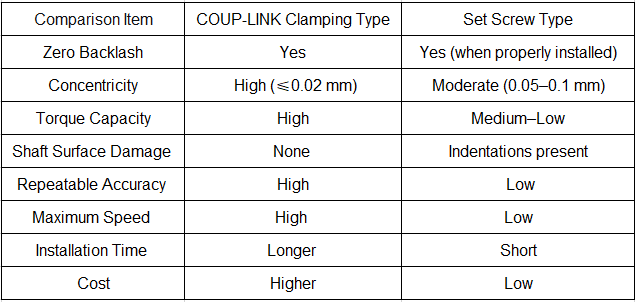
The selection of connection method for rigid couplings directly affects the precision, service life, and cost of the transmission system. The COUP-LINK LK13 series offers both clamping type and set screw type solutions to meet different application requirements:
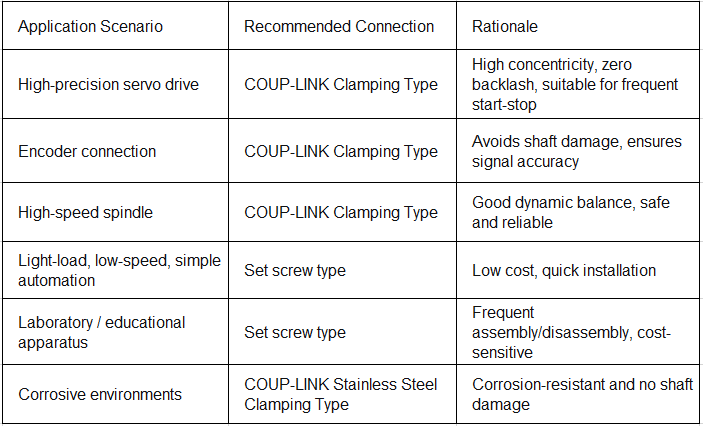
The clamping type, with its high concentricity, no shaft damage, high torque capacity, and excellent dynamic balance, is the preferred choice for high-precision, high-speed, and high-reliability applications.
The set screw type, with its quick installation and low cost, is suitable for light-load, low-speed applications where precision requirements are moderate.
In the niche field of rigid couplings, COUP-LINK offers high-reliability connection solutions for precision transmission with dual material options (aluminum alloy and stainless steel), multiple accuracy grades, and flexible choices between clamping and set screw types.
Correct selection should comprehensively consider torque, speed, alignment accuracy, assembly/disassembly frequency, and environmental factors. For the vast majority of precision transmission scenarios, the COUP-LINK clamping type rigid coupling is the superior choice.
Coup-link
